We are wired to notice what is wrong. Every deviation from a happy, balanced state is quickly noted in our brain, causing our focus to move quickly to the “disturbance” and to find a way to get us back into balance.
It could easily lead to becoming one-dimensional though: if we spend all our thoughts on what’s wrong, and less on enjoying what is actually good in daily life. For example, imagine being sick and walking outside, the focus would rather be on the pain or discomfort felt, but probably not so much on the wonderful sunshine or the first buds of spring.
But exactly in such situation: wouldn’t it be better to actively notice the good things in life and to enjoy them? They might be small, they are no magic wand, they don’t solve the problem at hand, but they could soothe and support.
Making it a habit to notice the things that bring me joy and then hanging on to them often helped me to re-focus my thoughts, simply because it widens my perspective. Nothing is only black or white, and why should a day be “a bad one” just because of momentary discomfort?
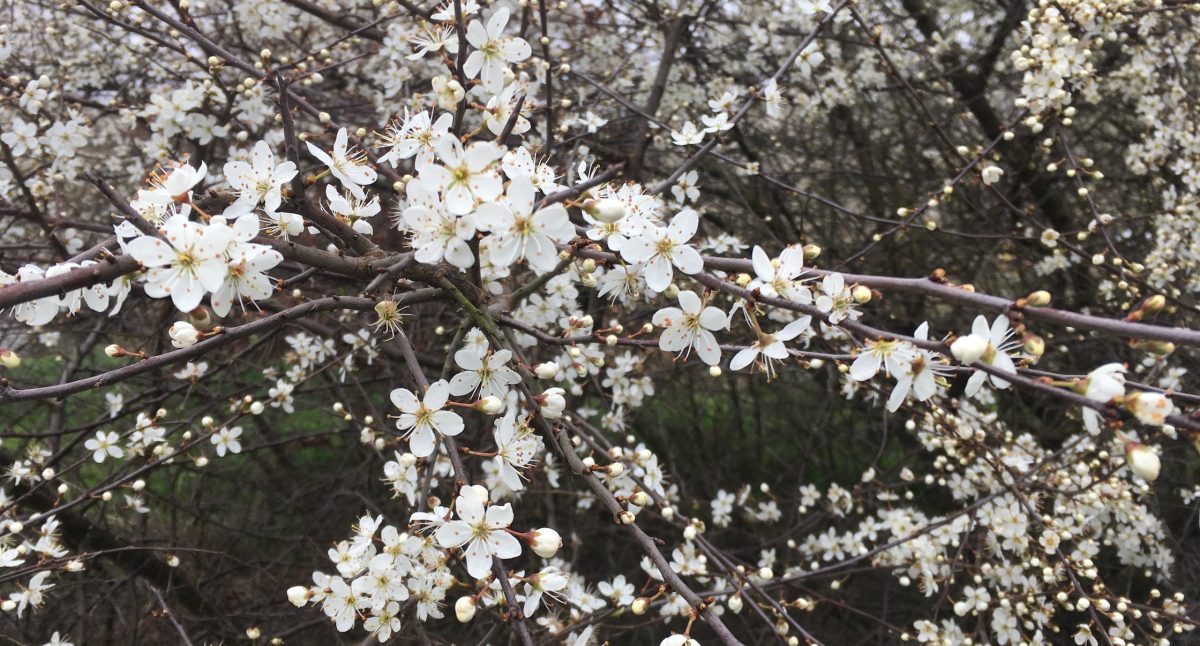
I had the chance to practise it again a few weeks ago. On my way to the neighbourhood pharmacy I always pass a rectangular stretch of nature situated between two rows of houses. The many trees on it were in early bloom at that time. Each year, it’s a spectacular view: an abundance of delicate white blossoms covering the branches – as if each twig were tucked into a fluffy sleeve. Of course it put a smile on my face.

On my way back, I stopped there again, relishing the moment. And I am never the only person pausing, gazing up to that fragile beauty and taking pictures of it – every year again. Turning around, I saw another woman looking in awe at this wondrous sight, and we smiled at each other, sharing our enjoyment.
Finding bliss in the small things is so important. It makes sure our current focus on a specific topic does not turn into a tunnel vision. Life is made up of so much more.
It’s also a very practical approach to creating our own happiness.
Happiness is not as elusive as one might think. Especially once we understand that it does not come from outside, but that it’s our responsibility to create it within us.
Yes, we are responsible for our own happiness, and taking that responsibility is essential.
Yung Pueblo
To expect another to resolve all of our issues and give us the happiness we desire is to expect to see the sunrise without opening our own eyes. it is to ask a river to give us nourishment without dipping our own hands into the water. another cannot answer a riddle that was only ever meant for our own minds to solve. the universe seeks to enlighten and empower us, thus it is only rational that we are our own greatest healers.
As long as we project our expectations onto someone or something else “to make us happy”, we are like a leaf in the wind. But we actually have agency here and should use it.
It starts with the thoughts in our head.
Being the creator of my own thoughts, I have a choice which thoughts I create or dwell on. Our minds are very busy with thinking the entire day, we could never stop even if we wanted to. But which thoughts are helpful and good for us?
How are we looking at life and at ourselves?
How do we treat ourselves, talk to ourselves?
What do we do to make ourselves feel better when we are in the dumps?
It is wonderful having friends who could cheer us up. Especially when feeling down, having a conversation with a friend has uplifting, even healing qualities. It can feel like different colours appearing on the horizon once the rain-front has passed.
And on the flip-side, isn’t that exactly how we would want to support a friend in need?
So, what about being our own best friend in tough times?
Which means: finding out what helps and then doing it. What has the best chance to get me through a hard situation? What could I do for myself?
And that always starts with my thoughts.
The hard part is – as always – actually doing it. But everything worthwhile is hard.
Happiness is events minus expectations.
Mo Gawdat
And it is of course, not easy to always pick yourself up and keep going, whatever you are going through. Knowing that nothing lasts forever and everything passes eventually, is one thing. But while being in the middle of the storm, it is ok to have doubts.
What I experienced during a recent infection that stopped me in my tracks for a few weeks: My lack of energy meant cutting back on my healthy routine – without getting a bad conscience about it, knowing and re-assuring myself that things would get better eventually.
It also meant procrastination on and resistance to everything that took too much energy. A lot of stuff fell through the grid that way, not only my never-ending action list but all social activities.
I acknowledged my doubts and hesitation, feeling low, my impatience. I gave myself some leeway and lots of self-compassion, taking refuge in small things, reminding me of the ever present positive signs around me.
My friends were always there for me. And I made sure I was a good friend to myself as well. Daily practice.
Happiness comes from within and only from within, and that requires to change our expectations to life.
The moment you know how your suffering came to be, you are already on the path of release from it.
Buddha
 The Positive Choice
You must be logged in to post a comment.