Life’s impermanence

Preparing the move of my parents to a care home during the past months brought up sad feelings for me, very suddenly. The time has come to say farewell to their apartment they have been living in for 12 years and to the life they were used to.

It’s a journey coming to an end, and it’s also a first farewell we children have to say, before the final chapter approaches.

It is sad. Sifting through all their belongings, deciding what they will take with them, what my brother and I will take with us, and what will be given to charity is after all, a hard step. 

Right now it takes place only in my mind: trying to remember what’s hidden in their cupboards and drawers, and where I need to watch out for possible surprises once I will be on site in a few weeks’ time and actually doing it. 

As usual I want to preempt getting stuck in the process by something that I have not thought about up front, because I want all to go well. It is a tight schedule for both my brother and I – him living in a different city than my parents and me living in a different country.

All their possessions – many of which are very dear to them – tell a lot about their life together, about their hopes, aspirations, love and struggles. It’s what remains of a life.

It is not just about the complex organization of their move, it has a very emotional component.

I want to give them the chance to be happy in that new place, but I am also aware that it will be quite a shock for them. The loss of control and full dependency on others is the reason why a lot of people who move to a care home facility die within the first 2 months.

Many objects they were used to and saw daily will no longer be around them. That goes for crockery and cutlery, their wineglasses, their bedlinen, their towels. They will be dependent upon others to wash their laundry, clean their space, give them food, or even a spoon for a tea bag. They will not brew their own coffee anymore in the morning.

On the other hand, of course, a weight is taken off their shoulders. They have not been able to cope anymore with daily life for a long time and struggled a lot. But there is a downside to everything and I know it will not be easy for them to adjust.

I want them to be happy, but all I can do is trying to soften their landing in that new reality. By being mindful and attentive, and making sure they can feel comfortable and have sufficient objects around them which serve as a reminder of past times. Like books, plants, photos, paintings, placemats or decoration. It’s often the small and simple things that bring joy.

I also need to acknowledge their feelings and deal with difficult situations that might arise, especially with my mom. My dad is easier to handle: he is pragmatic and accepts his dwindling capabilities – physically and mentally. But my mom is fighting reality as always, so for her it will be hard. Deep down she knows it is the best solution and she even said so in her more clearer moments, however, even her dementia will not let her ignore the obvious: that it is a big change.

Personally, I need to deal with these aspects as well: the factual side which means intensely project managing a lot of stuff, but also handling the emotional impact it has on me. It is hard. And I have no guarantees that my parents will be happy. I can only strive to enable it as much as possible.

Have a little faith
You’ll see it’s alright
Take a little time to breathe
The tide turns eventually
It comes in, it goes out
If you’re ever in doubt
Just have a little faith.

(Have a little faith - Son Mieux)

Going through this process turned out to be a reminder of the nature of impermanence. It reminds me of my own mortality, and that we cannot take any worldly belongings with us when it’s time to go.

My parents will lose a place they loved, but I realized that I will lose that place, too. The sadness I felt surprised me a bit at first because I have no strong connection to that place, but this feeling arising showed me what lies underneath and what I need to acknowledge for my own life.

And it made me question all the stuff that I have accumulated in my own apartment, and whether it is about time to gradually let go of more of it, bit by bit. Doing it feels liberating.

We come empty-handed into this world, and that’s how we will leave it. All of us. It’s important to have no illusions about it.

This is what the 5 remembrances mean in Buddhism:

We are all of the nature to grow old, to get sick and to die. There is no escaping that.

We will lose the people and the places that we love.

The only things we can take with us are our actions.

(Plum village podcast episode 82)

Even though these words might feel like a threat hanging in the air, it actually helps to focus on the present moment which needs our full and undivided attention. In the present we need to fully show up. Whatever we do, whoever we are with. 

Enjoy and appreciate what is in front of me and be grateful for it. The present moment turns into the past in the blink of an eye.

Everything in life is subject to change. That is just reality. That change is not meant to haunt or to taunt us. Its purpose is to teach us every day to be grateful and focus on what is really important in life.

Whatever I am currently working on, all the plans I make – which importance will it have in 50 years from now? Impermanence puts things into perspective when my head starts spinning.

Resorting to meditation whenever I felt overwhelmed by the complexity of the current situation, helped me. That’s why I keep on doing it as often as I can, striving for a daily routine. Like this morning when I got up with my head full of racing thoughts, then decided to stop myself in my tracks by sitting still and focusing on my breathing for 15 minutes. It brought me calm and I felt better equipped to start my day.

Of course, all my planning is a mere attempt to gain as much control as possible over the future. 

It does not mean everything is actually going to work out as I want to. But my worries might also not come true. 

The thoughts I started repeating to myself: it will work out eventually. There is no reason why all things should go wrong. And when issues come up then I will manage them. It’s not the end of the world. 


The memory tree

My Christmas tree is actually my memory tree. 

Every year again I decorate it with mainly the same pieces of Christmas decoration that I collected over many years, from different countries. Some I bought, some I received as gifts from friends or family or people I have been working with, and some I made myself. 

All these pieces carry memories with them which I treasure, reminding me of past times and people. Souvenirs. Each year I thoroughly enjoy decorating my tree, and in the weeks approaching Christmas and beyond, I often look at my tree, evoking the happy memories connected to these items. 

It makes me feel at home, grateful for the friendship I received, those enjoyable moments with others, the time I got to spent in different countries. It’s the feelings connected to these objects that come up every time I look at them. 

With time, I have some stories to tell which are connected to this small collection – which consists of so much more than just beautiful objects. They represent different times and stages of my life’s journey.

There is the Romanian ornament egg I received as a gift from my colleagues when I visited them in Bucharest some years ago (not long before covid made travel impossible). That’s how I learnt that these eggs are also used as Christmas decoration in Romania.

The beautiful felted heart and the Newbridge Christmas tree hanger which my Irish friend Naomi gave to me.

The colourful hangers I bought in one of the pound shops I frequented in Dublin so many years ago, which still have not lost their colours.

The nice and practical Dutch paper ball ornaments I got in the first year after I moved to Utrecht.

Quite a few handcrafted delicate wooden Christmas tree ornaments I found at German and Dutch Christmas markets.

And of course, my own creations like the crocheted snowflakes and felted stars.

The tree itself is also part of the collection. I bought it while living in Dublin for 12,99 Irish pounds at Penney’s, and it is now some 25 years old (and still looking good). It has moved with me from Dublin to Germany and then to the Netherlands. Meanwhile its losing some of its fake pine needles each time I take it out of the box or store it away again – which I did today.

All these memories are my very own, they live and will die with me,  like a lot of things existing only in someone’s heart. Sometimes we might tell a story or two to a friend about what a specific object means to us. Otherwise, this fabric of life remains largely hidden. I love to share some of these stories with my friends. It’s like giving them a present, sharing a piece of my life with them.

A friend of mine used a lovely expression when sending me her wishes for this New Year: We have an empty year in front of us waiting to be filled with good and heartfelt friendship. 

That’s a fitting description of what I am planning to do, continuing to create many more moments of joy and happiness with the people I love and cherish. Creating memories we will hold on to.


Memory is the diary that we all carry about with us. 

Oscar Wilde


For more inspiration have a look at my resources section.

You’ve come a long way, baby!

As the year is drawing to a close, let’s take this opportunity to look back for a moment. Think about how far you have come since the start of the year. Or if you prefer otherwise – in the last 3 months. Whatever time period you choose to compare against the present moment, you will notice a difference. 

You have learnt a lot, probably acquired a new skill, or stopped doing something else you suddenly discarded as not being good for you. You might have let go of old baggage, transformed an old habit or established a new one.

Either way, you have moved forward. You are a different person than you were before.

Isn’t that the way we need to be looking at our life? How far we have come, instead of regretting how far away we still are from achieving our goals or realizing our dreams?

I believe it is a much better measurement of individual success. One that isn’t apologetic or downplaying the many times when we get it right. One that’s not focusing on our imperfections or the many times we slip.

We all tend to put ourselves down a lot, unnecessarily in fact. Perfection neither does exist nor is it desirable anyway. But it blinds us to the small successes along the way: how often we try and the numerous times we do manage well – which we should be celebrating.  

The important thing is that we keep on trying, and become more aware of the chances life is offering us every day. The chance to choose a different response, and to make a difference by doing it.

We can only try to take the right decision at the time and do our best. How it will turn out eventually is not foreseeable in all aspects and beyond our control. And we only have control over ourselves, not over others or fate. 

Moving through life like this is humble, confident, and so much more joyful.

As Sia is singing in “Flames”:…Go, go, go figure it out, figure it out but don’t stop moving…. You can do this.

Not so long ago, it was important to me to “get things right” each day – an aspiration to become who I strive to be.

Looking back on it now, I have managed meanwhile to feel happy about the stuff I sometimes do get right, and I don’t punish myself anymore for my mistakes. I accept this to be the normal life of a normal person that tries, trips and falls, learns from it and tries again to do better the next day. 

Tomorrow is always another chance to become “the best version of myself” – that phrase from my online yoga teacher Adriene really stuck with me. 


Sometimes you need to take one step back to take 2 steps forward later.

Buddhist saying

As it stands, I can look back on quite an eventful year. 

In January, I suffered from exhaustion, couldn’t work, felt overwhelmed by my physical and mental situation. 

So, I got help, and as the months passed, I learned to listen to my body, to connect with myself and to slow down. I understood how vital it is to manage my energy well. Realizing my patterns, setting boundaries, learning to give myself more credit and giving me the time needed for healing. 

It’s true: these things just take the time they need, and you cannot accelerate your healing path. In the end, I dropped my unrealistic expectations of what I should or shouldn’t do or who I should be. To just acknowledge my limitations and start out from there was – in a sense – liberating. 

And indeed, things got better with time. To summon the patience and confidence to trust the process while going through it was not always easy for me. When you are in such a the moment, then self-doubts and fear are ever-present.

But most importantly: I decided to make peace with my past. Whatever baggage I carry around is a part of me, my history. There’s no need to hide it or feel bad about it. No need to explain myself. I am enough the way I am. 

Sounds easier than it felt for me at the time. When I listened to Brother Phap Huu (Plum Village podcast “The way out is in”) talking about this concept of embracing your past and your habits, it attracted me instantly as the right thing to do, however, I did not know exactly how to do it. All I knew was I wanted to go down that path.

Turned out that the act of taking this decision was actually enough to set things in motion. Once I decided that was what I wanted, things started to move. I moved forward. It has taken me a long time to get to this point. 

I am still working on transforming my habits and know this will continue. They will not disappear by power of magic. In practical terms: the key is to understand them as part of me, but without handing them the control over my life. 

That’s all. A demystification which might help to put things into perspective. It certainly helped me to make sense of it. (In case you assumed otherwise – Buddhist practitioners are very much down to earth, that’s why their advice is so infinitely valuable.)

Bottomline: It feels good to have learnt a lot about myself this year and to have put it into practice.

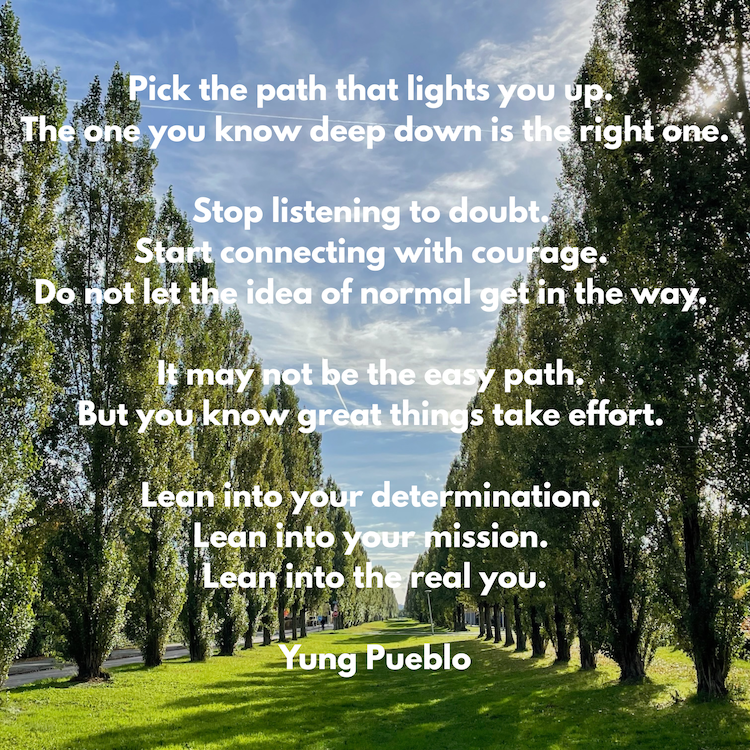
Here’s to 2024 – my wishes for all of us are for new insights, more patience with ourselves, equanimity, and the courage to walk our own path.