How do you talk to yourself?

Many of us tend to engaging in negative self-talk. It happens often unconsciously, we are so used to doing it without questioning it.

Watching my favorite show, The Great British Bake Off, I noticed this behaviour among the candidates as well, many times, men and women alike. Putting themselves down, being overly self-critical or calling themselves “stupid” when making a mistake.

I did that myself many years of my life, thinking that I needed that sort of criticism because I messed up so often. Well, let’s face it: messing up is part of being human. It’s totally normal to make mistakes, but in my mind it was not because I expected perfection from myself. 

Since then I have learnt a lot and moved on. What I focus on now is doing things in a slow manner for starters and not judging myself when I make a mistake, whatever it is. Beating myself up is not going to change what has happened anyway. But it releases stress hormones in my body, damaging my wellbeing in the long run. It’s not worth it.

This reflex is hard to stop though. Human beings are innately judgemental, towards themselves and others. It’s so easy to point out the obvious: what went wrong and then to punish ourselves or somebody else for that mishap with words. Children pick it up from their parents, and might still experience at school that mistakes are followed by ridicule and punishment.

Doing things slowly and focusing on what I do, one thing at a time, is a good way of preventing mishaps in the first place. Whether it is at work, while cooking a meal or communicating with others. It requires intention, concentration and being present. No multi-tasking.

When I am not present but being somewhere else in my head, that’s when mistakes are bound to happen. That’s why rushing in stressful situations is never a good idea. 

Ambulance workers for example don’t rush when they arrive on the scene of an accident. They are very intentional in their movements and that requires a lot of training and self-awareness. This approach certainly serves the people needing their help best.

But once I (inevitably) mess up I try to stay calm and breathe, and then continue on with whatever I was doing. No blaming, no complaining, just taking a few breaths and then calmly continuing. No need to wreck my day by making myself feel inadequate.

That I managed to get this far is a huge achievement already. In the past I used to call myself an idiot. I have moved beyond that since.

I am human thus I am not perfect and I don’t have to be. And that’s what I am telling myself.

The temptation to get angry in that kind of situation is of course always there. Any deviation from my self-expectations can trigger me easily. 

A big recurring challenge for me is when my day does not go according to what I planned. Hardly any day unfolds according to plan, in fact. This is just my normal reality and I decided that getting angry with myself over it is not helpful. This has now become my practice of accepting a degree of uncertainty in my life and going with the flow. 

No chiding myself. No judgement. Be open. Just breathe and let go.

I repeat these words quite often in my head.

Good point in fact: don’t forget to breathe. In stressful situations I tend to hold my breath, therefore I give it extra attention.

That’s step number 1: quitting negative self-talk and allowing myself to make mistakes.

Moving on to positive self-talk is step number 2: acknowledging and encouraging myself. You did good. You’ll be fine. It’s ok to feel that way. 

It takes a while to internalize it, but things do get better. It takes awareness and constant practice. As always, I really need to make an active choice to change my behaviour and aim to responding instead of reacting.

Accepting life as it is. Accepting what is (Byron Katie). Accepting the inevitable.

It sounds easy but is so hard. It’s a very big deal, in fact. It makes you humble, realizing just how fallible we humans are and that nothing in life is a given.

We do not need to know or understand or be able to fix everything, or to slide through life perfectly well. These were once my beliefs I setup as a child. I let them go since and found more peace. They are still surfacing sometimes but they don’t control me anymore.

Riding the waves of life, navigating the everyday currents is essentially like bouncing up and down. This practice takes courage, acceptance and humility. 

The only thing we can do is trying, every day again, to do better tomorrow and to treat ourselves better. 

And acknowledge our small victories every time we succeed. 

Making peace with myself

The package each one of us carries around is unique and bound to stay with us for the rest of our lives. It is our individual conditioning that led to certain habits, behaviours and struggles that come up once and again. 

How we deal with it is up to us. But we need to understand that we will never get rid of it and have a clean slate. 

What we encounter in life has an impact and spins us into a certain direction. We often carry a lot. Imagine abuse, neglect, accidents, violence, loss, illness… Life is easily disrupted.

Whatever it is, it leaves an imprint and makes us very special – and also a bit weird. In fact, everyone is weird because of it. There is actually nobody who would be considered as “normal”. What is normal anyway? Is there anyone who doesn’t suffer? Certainly not in this universe.

If it’s any consolation: we are all weirdos in a way, trying to cope with life’s challenges the best we can. What is differentiating us is how we move on. 

Because you are alive, everything is possible.

Thich Nath Hanh

It often feels scary because it is stepping into unknown territory. But there is also always a chance, because life is full of surprises and unexpected turns. A chance that things could sometimes turn out well. A chance to learn through our difficulties and grow. A chance to actually make a difference in the world because of it.

We take different paths in life based on our suffering: it influences our life choices. For a time, it’s ok to grieve the loss of options no longer available to us. The loss of an alternative reality that was taken from us. The different person we could have become without the event in question. 

But we cannot change the past. 

Instead, let’s trust that there is a reason for everything even if we don’t see it at the time.

To take that leap of faith could at times feel overwhelming. It is so much easier to remain in the blame game and the regret, wasting time wishing for a magic wand to change reality, or for an external force to solve all our problems.

Stepping out of this cycle, taking ownership of my conditioning and the consequences it had for my life often feels hard, huge and exhausting. 

I understand the importance but acting on it is a different story, and I don’t always succeed, but I accept my own pace. 

Suffering teaches us. It is a part of life. We might try to run away from it out of fear that we couldn’t cope. I would surely like to eliminate all fear and suffering from my life. Honestly, who wouldn’t?

And yet, the purpose of suffering is not to make it go away. Knowing and allowing it means: we also know happiness. Every coin has two sides. So be grateful and enjoy the happiness you have in yourself already, right now!

It is real freedom when you know how to care for yourself. To be responsible. We need to be very mindful where to put our energy, make sure not to lose ourselves. Be true to what your responsibility is. To be who you are is to know how you show up.

Thich Nath Hanh

What I found truly liberating: not justifying myself anymore for who I am. Nobody has to justify themselves for the life events that shaped them! 

When I was younger I tried to hide my true self and fit in, well knowing that I always kinda stuck out. Now I am proud to be weird!

And here is another comforting truth: you become who you are because of what you go through, but also in spite of it.

To stand by myself, to acknowledge my wounds set me free. It took me a while to embrace all of it. And I am still getting to know myself better each day, discovering new aspects of myself, humbly realizing that it’s ok not to be perfect.

To listen to myself, to accept myself, have compassion with my struggles, habits and failings, to actually like who I am.

To love what I find inside of me, be grateful for it and accept what brings me suffering. Not judging myself for it or trying to hide it. Not suppressing, ignoring or denying it. Not numbing the pain. It’s neither shameful nor embarrassing. Sweeping things under the rug gives them more power, so that way they always resurface –  and I do not want them to be in control.

Befriending my fears, my habits by making my peace with them. Letting go of my expectations and my anger about why things are as they are, about my limitations and my pain. Instead giving them the space they deserve and accept them as a part of me.

The feeling this concept transports felt very attractive when I heard it the first time on my favourite podcast “The way out is in”. At first, I could not fully grasp it but quickly followed my instinct saying “yes, I want to move into that direction”, and then things started to turn around. After a while I felt much calmer and more content.

You already are what you want to become.

Thich Nath Hanh

Allowing myself to be the way I am with the whole range of positive and negative sides felt like finally giving myself some rest.

Because all aspects – good or bad – belong to me and my history, have shaped my character and influenced my behaviour, my preferences and priorities, my approaches, dreams and aspirations. 

Picking some positive daily affirmations can be very supportive. Mine are:

I am enough.
I am worthy.
I matter.
I deserve to be happy.

I also remind myself of all the abundance, beauty and love I have in my life.

The first step to transformation is making peace with my past and in fact, with myself. Having compassion for myself and my failings, accepting that I am a human being, thus fallible.

It’s easy and hard at the same time. It is not only a decision on a cognitive level but much more a deeply emotional topic.

I believe that when we do it, we also set others free, giving them permission to do the same. 

And we understand that everyone is in a similar situation, struggling like we are struggling. There is always a reason why people do what they do. 

That way we open up space for compassion in ourselves allowing for more kindness when interacting with others.

Be beautiful, be yourself. 

Thich Nath Hanh

How to create happiness

We are wired to notice what is wrong. Every deviation from a happy, balanced state is quickly noted in our brain, causing our focus to move quickly to the “disturbance” and to find a way to get us back into balance.

It could easily lead to becoming one-dimensional though: if we spend all our thoughts on what’s wrong, and less on enjoying what is actually good in daily life. For example, imagine being sick and walking outside, the focus would rather be on the pain or discomfort felt, but probably not so much on the wonderful sunshine or the first buds of spring. 

But exactly in such situation: wouldn’t it be better to actively notice the good things in life and to enjoy them? They might be small, they are no magic wand, they don’t solve the problem at hand, but they could soothe and support. 

Making it a habit to notice the things that bring me joy and then hanging on to them often helped me to re-focus my thoughts, simply because it widens my perspective. Nothing is only black or white, and why should a day be “a bad one” just because of momentary discomfort?

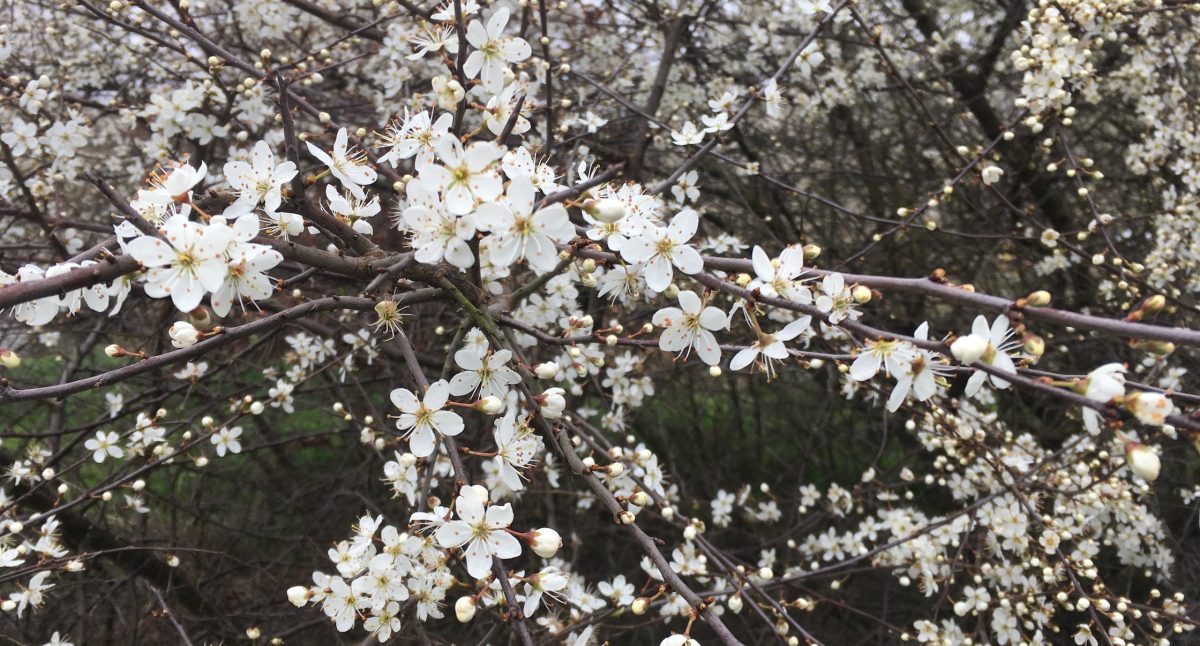
I had the chance to practise it again a few weeks ago. On my way to the neighbourhood pharmacy I always pass a rectangular stretch of nature situated between two rows of houses. The many trees on it were in early bloom at that time. Each year, it’s a spectacular view: an abundance of delicate white blossoms covering the branches – as if each twig were tucked into a fluffy sleeve. Of course it put a smile on my face. 

On my way back, I stopped there again, relishing the moment. And I am never the only person pausing, gazing up to that fragile beauty and taking pictures of it – every year again. Turning around, I saw another woman looking in awe at this wondrous sight, and we smiled at each other, sharing our enjoyment.

Finding bliss in the small things is so important. It makes sure our current focus on a specific topic does not turn into a tunnel vision. Life is made up of so much more. 

It’s also a very practical approach to creating our own happiness. 

Happiness is not as elusive as one might think. Especially once we understand that it does not come from outside, but that it’s our responsibility to create it within us.

Yes, we are responsible for our own happiness, and taking that responsibility is essential. 


To expect another to resolve all of our issues and give us the happiness we desire is to expect to see the sunrise without opening our own eyes. it is to ask a river to give us nourishment without dipping our own hands into the water. another cannot answer a riddle that was only ever meant for our own minds to solve. the universe seeks to enlighten and empower us, thus it is only rational that we are our own greatest healers.

Yung Pueblo

As long as we project our expectations onto someone or something else “to make us happy”, we are like a leaf in the wind. But we actually have agency here and should use it.

It starts with the thoughts in our head.

Being the creator of my own thoughts, I have a choice which thoughts I create or dwell on. Our minds are very busy with thinking the entire day, we could never stop even if we wanted to. But which thoughts are helpful and good for us?

How are we looking at life and at ourselves?

How do we treat ourselves, talk to ourselves?

What do we do to make ourselves feel better when we are in the dumps?

It is wonderful having friends who could cheer us up. Especially when feeling down, having a conversation with a friend has uplifting, even healing qualities. It can feel like different colours appearing on the horizon once the rain-front has passed.

And on the flip-side, isn’t that exactly how we would want to support a friend in need?

So, what about being our own best friend in tough times? 

Which means: finding out what helps and then doing it. What has the best chance to get me through a hard situation? What could I do for myself?

And that always starts with my thoughts. 

The hard part is – as always – actually doing it. But everything worthwhile is hard.

Happiness is events minus expectations. 

Mo Gawdat

And it is of course, not easy to always pick yourself up and keep going, whatever you are going through. Knowing that nothing lasts forever and everything passes eventually, is one thing. But while being in the middle of the storm, it is ok to have doubts. 

What I experienced during a recent infection that stopped me in my tracks for a few weeks: My lack of energy meant cutting back on my healthy routine – without getting a bad conscience about it, knowing and re-assuring myself that things would get better eventually. 

It also meant procrastination on and resistance to everything that took too much energy. A lot of stuff fell through the grid that way, not only my never-ending action list but all social activities.

I acknowledged my doubts and hesitation, feeling low, my impatience. I gave myself some leeway and lots of self-compassion, taking refuge in small things, reminding me of the ever present positive signs around me.

My friends were always there for me. And I made sure I was a good friend to myself as well. Daily practice.

Happiness comes from within and only from within, and that requires to change our expectations to life.

The moment you know how your suffering came to be, you are already on the path of release from it.

Buddha